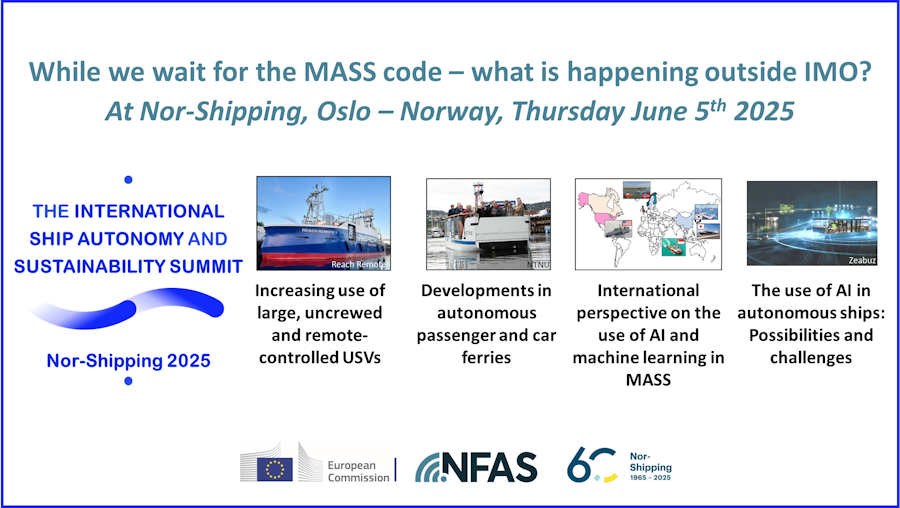
This year’s edition will first focus on applications of autonomy in non-MASS shipping, with a focus on larger uncrewed surface vessels and urban and coastal ferries. The second part of the summit will take a closer look at the role of artificial intelligence and machine learning in autonomous ships.
MASS developments are going relatively slow in national projects as well as in IMO. IMO expects to complete the voluntary guide in December 2026 and then go into a testing phase until the mandatory code is adopted in 2030. However, other non-MASS areas are rapidly being developed. This include large USVs (< 24m) and passenger/car ferries. Part 1 will take a look at these two segments and see what impact those can have on MASS.
The full recording of part 1 of the event is available on the link below. The program below gives the times in the recording for start of each part of the event.
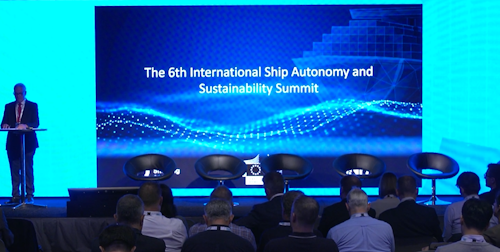
Trond Langemyr | Conference chair, Chair of steering committee
NFAS, Norwegian Coastal Administration
Video from previous summits
Moderator: Najmeh Masoudi-Dionne | Autonomous mobility
specialist, Future Mobility Europe
MASS developments are going relatively slow in national projects as well as in IMO. IMO expects to complete the voluntary guide in December 2026 and then go into a testing phase until the mandatory code is adopted in 2030. However, other non-MASS areas are rapidly being developed. This include large USVs (< 24m) and passenger/car ferries. This part will take a look at these two segments and see what impact those can have on MASS.
Bjørg Mathisen Døving | Vice President, Reach Remote Ottar Kringen Mæland | COO DeepOcean Vegard Evjen Hovstein | CEO Maritime Robotics Pieter-Jan Note | Mahi, UltraTug remote operated Tug Magne Nilsen | Chief Underwriting Officer, Specialty. Gard AS
Moderator: An-Magritt Ryste | DNV Maritime Digital Product Portfolio Manager
Autonomous car and passenger ferries in national operation is also an area with relatively fast growth and rapidly increasing interest. Also, these are largely exempt from MASS regulations but may have significant impact on further developments, even if IMO’s work on MASS code explicitly excludes passenger carrying ships.
Erik Froste | CEO Swedish Riad Ferries Jelmer de Lange | Dutch Rijkswaterstaat Dag Hole | Norwegian Road Authorities Siv Remøy Vangen | Managing Director at Norwegian Electric Systems Erlend Solem | Head of green energy, Boreal
Fotini Ioannidou | Director Waterborne, DG MOVE, European Commission
Even Tronstad Sagebakken | State secretary, Ministry of
Industry, Commerce and Fisheries
While some look at AI and advanced automation as the necessary key ingredient in autonomous control, others look at it with scepticism and claim that it is difficult to use in safety related functions. This session will discuss possibilities and hindrances related to the use of AI in autonomous ship control.
The full recording of part 2 of the event is available on the link below. The program below gives the times in the recording for start of each part of the event.
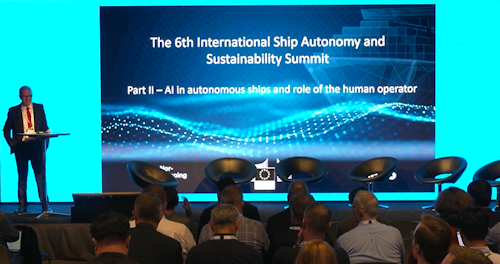
Trond Langemyr | Conference chair, Chair of steering committee
NFAS, Norwegian Coastal Administration
Video from previous summits, Slido presentations
Moderator: Ørnulf Jan Rødseth | Manager, NFAS
AI and machine learning seem to be an integral component of autonomous vehicles in most parts of the world. This in spite of many people pointing to problems with AI, e.g. in developing deterministic and testable control systems and in ensuring national control over the technology. What is the status of developments in Asia, USA and Europe and what outlooks do we have on AI in autonomous ships?
Jin Kim | Vice President, Korea Research Institute of Ships & Ocean Engineering
Hideyuki Ando | Director, Monohakobi Technology Institute, Japan
Sean Pribyl | Partner, Holland & Knight LLP, USA
Jacob Terling | Principal Administrator, European Commission, DG MOVE
Øyvind Smogeli | CEO/CTO, Zeabuz, Norway
Moderator: Barbara Sellier | Head of Unit DG MOVE Maritime Safety
One problem with AI is in developing deterministic and testable control systems. In addition, the geopolitical and security issues with some countries’ dominance may be seen as a problem. The human factor and the cooperation between human operators and AI-based control or decision support systems may also be an issue. Finally, how will the authorities and the class address these problems when autonomous ships using AI is in the approval phase?
John Alexander McDermid | Professor, University of York UK, safety of AI
Tor Stokke | Simonsen Vogt Wiig, International and geopolitical
Sveinung Soma | REMOTA, Human factor and cooperation
Erik Røsæg | Professor UiO, EU AI Act and other legal implications
Frank Børre Pedersen | Director Martime programme, Group R&D, DNV